Supreme Court clarifies key rulings on prisons, environment law, insolvency, and criminal matters
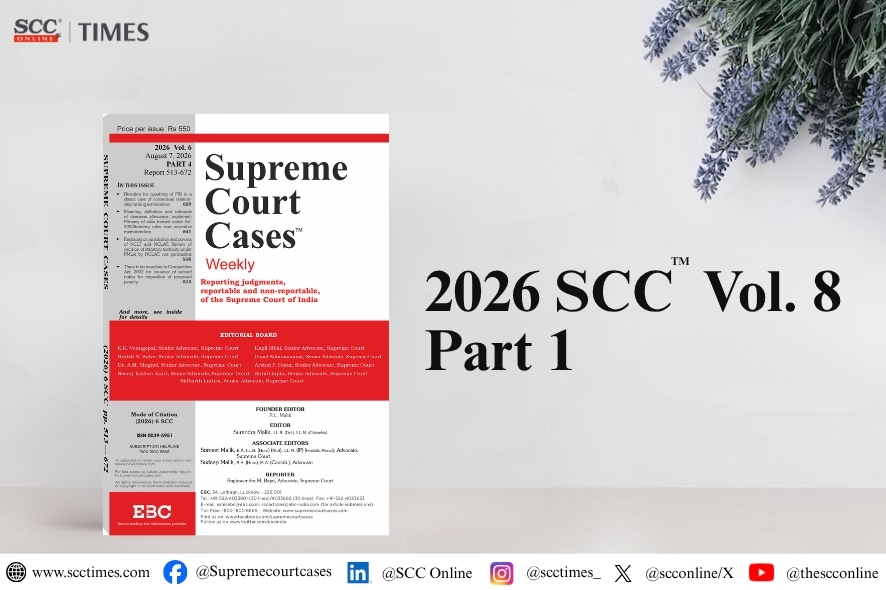
The Supreme Court has delivered significant rulings across multiple legal domains, as documented in Volume 8, Part 1 of the 2026 SCC reports.
In a major constitutional matter, the Court held that prisons and persons detained therein fall exclusively within the legislative domain of State Governments and Union Territory Administrations under Schedule VII, List II of the Constitution. Consequently, primary responsibility for framing and implementing prison policies rests with respective States and UTs, as per National Legal Services Authority v. Union of India.
On environmental matters, the Court clarified that directions to close manufacturing units for non-obtaining of prior environmental clearance are not sustainable when ex post facto clearance is found to be an appropriate remedy to rectify procedural lapses, per Neetu Solvents v. Vineet Nagar.
Under insolvency law, the Court ruled that operational creditors cannot pursue civil suits or arbitration regarding past dues following approval of a resolution plan under the Insolvency and Bankruptcy Code, 2016, as decided in Tata Steel Ltd. v. Varsha.
In criminal matters, the Court clarified provisions under the Nagarik Suraksha Sanhita, 2023 regarding police custody conditions, and held husbands liable for murder when offences occur within domestic privacy and adequate explanation is not offered.